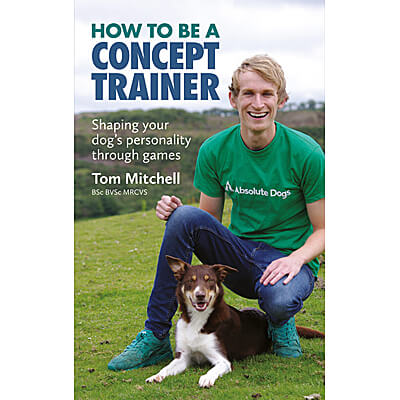
Author: Tom Mitchell
Format: Paperback
Length: 204 pages
Release Date: 2017
- Does your dog get so excited that he struggles to focus and process what you want him to do?
- Does he get frustrated when you are training a new exercise?
- Does he go into a new environment fearing that something scary may happen?
These three differing scenarios, which can apply equally to performance dogs and companion dogs, are barriers to learning and can also tarnish your relationship with your dog. But it doesn't have to be this way. In How to be a Concept Trainer, vet and behaviorist Tom Mitchell reveals his novel approach to training—and it's all about playing games!
The games are designed to teach your dog a concept rather than a specific behavior. For example, instead of teaching a behavior like sit or stay, you teach a mindset or concept like calm focus, optimism, or impulse control. The games allow you to work on underlying emotional issues and encourage dogs to make the "right" decisions.
Mitchell equips us with the tools to manipulate our dog's mindset, turn negative traits into positive ones, and help the dog reach their full potential!
About the Author
Tom Mitchell is a veterinarian, dog behaviourist, founder of Behavet and Help! My Dog, passionate dog trainer, and forever dog lover. His journey into dog training and behaviour transformation began long before any formal education, walking dogs across the fields of rural Yorkshire and dreaming of making a difference. Over the years, he has developed concept training into a proven method that transforms even the most complex behaviour struggles, from reactivity to separation anxiety to aggression and fear-based challenges. Behavet has supported thousands of pets worldwide, earning the trust of over 7,000 veterinary professionals and 300 veterinary practices and becoming the world's largest online veterinary behaviour clinic.
In Chapter One, Mitchell begins by looking at a dog's available choices in any new situation, and the tools we have at our disposal to affect these choices, these being; management, reinforcement and punishment. He provides an expanded description of each of these. As learning can happen outside of our input, Mitchell stresses the need for rewarding the "right" choices, as well as considering the number of available choices to our dog, which is where management comes in, prompting the introduction of the choice reward framework.
Chapter Two focuses on how we go about rewarding the right choices. Mitchell talks us through the following five elements that make up a reinforcement strategy:
- Markers
- Reinforcers
- Delivery
- Schedules
- Rates of Reinforcement
Chapter Three moves on to focus. In training, focus is split into both trainer focus, and forward focus, such as looking down a line of jumps. Mitchell shows us a number of games to work on building both of these. He also studies building focus as a concept and stopping unwanted behaviours.
Chapter Four concentrates on flexibility. By this, Mitchell means does your dog respond to something in the same way every time, or does he take on a more flexible approach. A flexible approach is more desirable as we often require the dog to approach the same situation differently, for example, stopped vs. running contacts. Mitchell provides us with games to build flexibility and also highlights the value of reward flexibility, discussing reward switching, and how to avoid reinforcer disappointment.
Chapter Five takes a look at thinker and doer personality types. Dogs can be roughly divided into either thinkers or doers in their approach to making choices. While achieving a balance between the two is essential Mitchell describes doers as preferential in terms of training, and shows us how you can develop your thinking dog into a doer.
In Chapter Six, Training through Inspiration Not Deprivation, Mitchell argues the goal is to create a dog susceptible to reward-based training. He looks at what determines the value of a reward, as well as how to take simple, common place behaviors and turn them from deprivation to inspiration, turning distractions into success, and building reinforcers and creative reinforcer development.
Chapter Seven considers generalization, which Mitchell sees as crucial for success. He goes through the pros and cons of being a good generalizer, and provides us with a number of games to help your dog become a skillful generalizer.
Chapter Eight introduces "grit" as a training concept. This concept is now widespread in human psychology and Mitchell anticipates the same will follow suit in the dog word. It basically means the ability to work for less frequent or longer term rewards, and he once again provides games to develop this.
Chapter Nine looks at arousal. Although key to success in many different areas, we must be wary of overarousal. Mitchell explains this in terms of the "arousal bucket," explaining that when arousal goes over threshold you start to experience problems. He also comments on the time span of arousal as well as the relationship between desire, frustration, and fear.
In Chapter Ten Mitchell discusses training for calmness. He believes a calm dog is a happy dog and lists some of the benefits of a default calm emotional state. He shares with us his calmness protocol and also mentions calmness training in multi-dog households.
Chapter eleven continues with the subject of arousal. As earlier discussed some level of arousal is essential and Mitchell takes us through the differences between good arousal and bad arousal, as well as the difficulties of finding the optimum arousal level, and how this is an even greater challenge when it comes to dog sports.
Chapter Twelve highlights the importance of thinking in arousal, and how this is critical to success with both sport and companion dog training. Mitchell provides us with some games to promote thinking in arousal, as well as looking at how to achieve optimum arousal levels.
Chapter Thirteen considers how to manipulate arousal. Mitchell explains that to achieve and maintain arousal, and avoid over-arousal in situations where we do not want it, we must learn how to manipulate it. He therefore takes us through the tools at our disposal to do this, which include reinforcement, arousal specific games and on and off switch behaviours.
Chapter fourteen concludes the topic of arousal by looking at how to develop the ability to switch between high and low arousal, something which is vital for performance dog. Mitchell also discusses the relationship between overarousal, fear, and frustration, as well as the importance of arousal when it comes to building emotions.
Chapter Fifteen moves on to frustration, and crucially, tolerance to frustration. This is important for a number of reasons, to name a few, it enhances learning and performance by creating a dog able to deal with failure, equips the dog with a better tolerance to handler mistakes, and makes them more resilient to change. Mitchell also looks at the link between frustration and reactivity, as well as the difference between grit and tolerance of frustration.
In Chapter 16, Training for Optimism, Mitchell explains why optimism is a fundamental concept a dog must have in order to be successful, also elaborating on the pitfalls of pessimism, and how this can even lead to reactivity. He provides us with indicators to determine whether your dog is a pessimist or an optimist and how we can use games to help turn the former into the later.
In the final chapter Mitchell considers the concept of movement. Although rarely considered a training concept, Mitchell points out that all competition and companion dogs spend a large amount of time moving. Therefore it is possible to create optimum movement form through rehearsal and reinforcement. As well as providing games to enhance movement, Mitchell also looks at advanced gait work for fitness and protecting movement, which he describes as limited rehearsal of bad movement patterns, such as limping.
Finally, Mitchell concludes that by becoming a concept trainer you can turn struggles into strengths. By applying the above, you can develop and strengthen behavior traits that suit your dog, his job, and you, as well change and manipulate mindsets in order to realize your dog's full potential.
More than 100 five-star reviews!
"The only dog training book you'll ever need." —Sharon J. Warwick
"This book will give you the tools to turn struggles you may be having with your dog to strengths." —Karen Baldam