Author: Jo-Rosie Haffenden
Format: Soft cover with spiral binding
Length: 128 pages
Release Date: 2015
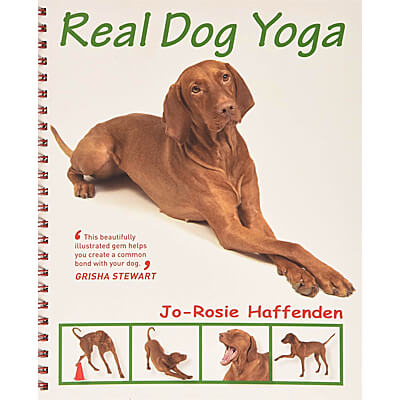
In Real Dog Yoga, Jo-Rosie Haffenden, accredited trainer and behaviorist, and expert witness for the courts in dangerous dog cases, introduces us to the fascinating and wonderful new concept of Dog Yoga. Inspired by her badly abused rescue dog, Archie, Haffenden developed a technique that calms and relaxes, improves focus and impulse control, and promotes body consciousness. Using a mixture of postures, movements, and expressions, Haffenden shows us how to teach our dogs to be calm, relaxed individuals and prevent the escalation of behaviors borne from frustration. This is an inspired and thought-provoking approach to training, and one that will hugely enrich the lives of both pet and so called "problem" dogs, strengthening the all-important bond between dog and owner.
Dog Yoga is a mix between equestrian sport dressage, canine obedience, and animal trick training. This differs hugely from Doga, an unfortunate trend of people doing human yoga with their dogs. Real Dog Yoga is based on the idea, supported by research, that physical posturing and expressions can influence a dog's emotional state. It trains sequences of positive and calming postures, practiced in a sequence to promote good mental, physical, and emotional health, as well as calmness. It consists of 30 postures, 15 expressions, and 10 actions, training dogs in muscle control, body consciousness, focus of mind, and impulse control.
Why might we want to teach our dogs to practice yoga? The author comments on the high expectations we place on our dogs and how the majority of dog owners fail to teach calmness. Signs and signals that dogs may exhibit in the wild are often ignored or cannot be used in a domestic setting. This is is often the seed of frustration and stress which can develop into fully fledged behavioral problems. Rewarding the calm postures and calm, soft expressions practiced in Dog Yoga increases the natural occurrence of these behaviors. These benefits apply to high-drive dogs who need an outlet for their energy, rescue dogs, puppies, and any dog struggling with fear, frustration, or focus. Haffenden has also found specifically cued sequences that help to de-escalate dogs, a technique she found hugely successful with her rescue dog.
Highly praised by top professionals, Sarah Fisher, TTouch instructor and behavior counselor says about this book, "Every section of this stunning publication resonated with me. It is utterly brilliant, thought provoking and so refreshing to read."
Grisha Stewart, creator of BAT (Behaviour Adjustment Training) comments: "The author creatively integrates force-free dog training with relaxation. This book helps you create a common language with your dog about body movements, not for the sake of tricks you can show off, but for the sake of the dog's own well-being. This beautifully illustrated gem helps you create a common bond with your dog."
About the Author
With a university degree in psychology and a post-grad degree in animal behavior, Jo-Rosie spent her early career working at a rescue center before becoming an expert witness. Later on, she was on Channel 4's Rescue Dog to Super Dog, ITV's Teach My Pet to Do That, and finally, Channel 4's controversial Train Your Baby Like a Dog.
Today, Jo-Rosie is an online and in-person lecturer with The School of Canine Science alongside co-founders Dean Nicholas and Nando Brown. They also offer a plethora of courses on the school's website covering topics such as dog behavior, domestication and evolution, puppy development and socialization, nutrition, endocrinology, physiology, sociology, and much more.
Section One discusses the environment for learning. Haffenden stresses the importance of not rushing the first stage of training and describes the ideal environment needed, including how to adapt it to suit the needs of an individual dog. Both the dog and the caregiver needs to be suitably prepared, i.e., relaxed and comfortable, before embarking on a training session. Haffenden then takes us through how the principles of learning that facilitate the teaching of dog yoga. These include play, experimentation, repeated practice, and fine tuning. Haffenden looks at training using treats, giving us some advice on getting the most out of each treat. She examines pace of training, frequency of reward, and optional clicker shaping, including some tips on training with the clicker and how it works. Haffenden also discusses shaping, break protocol, building duration with the clicker, and how to deal with frustration or boredom in a session.
Section Two gives step-by-step instructions for teaching Dog Yoga. Haffenden begins by explaining that there are 30 postures, which fall into three sets: Sit, Stand, and Down. Each posture teaches the dog to control his muscles and use his body consciously, helping him to become less impulsive. She then moves on to the 15 actions, explaining that they differ from the postures in that they are not held but are based on very slow, careful motions, teaching impulse control and focus. Finally the 10 expressions are used in dog communication; teaching them on cue helps with a more conscious communication. These are slightly more complex, and therefore they are the last exercises to teach. Haffenden takes us through all the exercises, giving informative step by step instructions. She begins with neck stretches, head tilts, and paw raises in the sit, including:
- Sit left neck stretch
- Sit right neck stretch
- Sit right paw raise (front)
- Sit left paw raise (front)
- Sit both paw raise (beg)
Haffenden offers some advice on chaining the set together, before moving on to the standing set, which includes:
- Stand right neck stretch
- Stand left neck stretch
- Stand head looking up (stretch up)
- Stand head to floor (sniff)
- Stand right paw raise (front)
- Stand left paw raise (front)
- Stand back right paw raise (back)
- Stand back left paw raise (back)
The standing set also includes tail control and Haffaden teaches us tail lifts, tail drops, and the tail wag.
Finally Haffenden shows us the down set, which consists of:
- Settle right
- Settle left
- Down with head on paws
- Down with head dropped to the right
- Down with head dropped to the left
- Down with right paw forward
- Down with left paw forward
- Down with paws crossed
- Down lying flat right
- Down lying flat left
- Down on the back
We then move on to actions, which include:
- Back four
- Forward four
- Left spin
- Right spin
- Left circle
- Right circle
- Head shake
- Full body shake off
- Bow
- Front right paw target
- Front left paw target
- Back right paw target
- Back left paw target
- All four feet on target
- Nose target
Finally, Haffenden shows us how to teach the following expressions:
- Nose lick
- Yawn
- Sign
- Smile
- Slow blinking
- Close eyes
- Ear prick
- Ears back
- Ear twitch
- Look at me
Section Three concentrates on the application of dog yoga for challenging dogs or dogs in challenging environments. Haffenden explains how it can be used in kennels, where boundary frustration, over excitement on the presentation of interaction, unwanted vocalization and destructiveness are common. She explains how Dog Yoga can help to help to combat this, as well as fear based problems, stimulating the dog as well as rewarding behavior which is appropriate. It is also useful for post-operative dogs, helping to keep them calm and stimulated during times of mandatory kennel rest, as the methods can be taught without touching the dog.
Recently Viewed Products