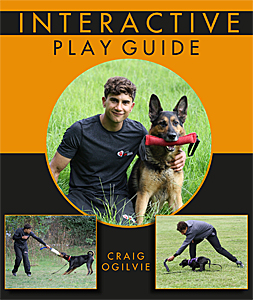
Author: Craig Ogilvie
Format: Paperback
Length: 192 pages with 80 illustrations
Release Date: 2017
Leading trainer and behaviorist Craig Ogilvie has studied all aspects of play and devised an interactive system that has produced amazing results for dogs and their handlers. The key is to discover what your dog really values and then find a way of playing that works for him. This builds motivation, helps you to achieve your training goals and, perhaps most important of all, is the means of developing and enriching your relationship.
Find out how to
- Choose the right toy
- Motivate your dog
- Empower your dog without losing control
- Use play as a reward
- Make that special relationship even more special
Using the acronym INTERACTIVE, Craig provides 11 lessons that will greatly enrich and improve you and your dog's play sessions. Ogilvie begins by explaining how his background in Mondioring, a dog sport where dogs are tested in agility, obedience, and the biting and apprehension of a trained and licensed person, has helped him shape his interactive play program.
"I" in the interactive acronym stands for invincibility. Ogilvie explains that the ways in which we interact with the dog during play is of paramount importance. He highlights some of the common misconceptions and mistakes that we commonly make, adding how these can reduce a dog's desire to play. Ogilvie shows us how with the right kind of interaction we can make our dogs feel invincible, teaching them to love the play experience. He takes us through some of these tactics, including even tug-of-war, proud parade moments, and learning from dog-dog play interactions.
"N" stands for nonverbal communication. Ogilvie describes how we can communicate with our dog during play without talking. He shows us how to use body language and positioning, as well as actions and associations to converse with our dog. He also adds how to determine whether your dog is uncomfortable with your body language, as well as provides tips on stance and posture, eye contact, distance, and movement. Ogilvie then considers physical contact with your dog during play, describing how we can use this for calming and positive stimulation.
"T" stands for toy selection. Ogilvie comments that choosing the right toy for your dog can makes a huge difference to his play experience. Factors to consider include: your dog's mouth shape, toy size, ad toy material. Ogilvie also offers advice on where to find the right toys and, once you have found it, stresses the importance of keeping it just for interactive play sessions.
"E" stands for energy effects. Ogilvie explains that energy is an important factor that is often overlooked. He divides it into two categories, physical and mental, beginning with mental energy. Ogilvie describes the impact that both positive and negative energy can have on your play session, and what we can do to change our mindset for the better. He then looks at physical energy, comparing an interactive play session to a short physical workout, giving tips on how you as a handler can increase your energy level. Ogilvie also considers your dog's energy level and how to tailor your play sessions accordingly. He then shares some common training mistakes that create confusion, and as a result, unnecessarily tire your dog both physically and mentally, giving advice on how to prevent this. Ogilvie then shows us some ways in which we can improve and maximise our dog s energy.
"R" stands for relationship building. Ogilvie emphasises how interactive play serves as a fantastic way to cement your relationship with your dog, and can become more valuable to him than other more natural desires, such as pulling on the lead and playing with other dogs. He examines why the interactive play experience is so powerful, citing one of the key reasons as the handler becoming the creator of the fun, rather than just the reward supplier. Ogilvie then introduces us to the Love for Dogs 80/20 system and the importance of individual interaction, which are two steps that help you to position yourself as the creator.
"A" is for activating the toy. Ogilvie introduces us to TAR, which stands for toy activation response, which is your dog's natural desire to chase things that move. He mentions the importance of finding your dog's activation buttons, with a detailed explanation of how to go about activating the toy. Ogilvie also provides some tips for dogs with a naturally low TAR, which include activation extension, activation location, and more.
"C" stands for control during interactive play. In this context, Ogilvies defines control as the ability to influence or direct behavior or the course of events. Its relevance to interactive play comes in the form of teaching your dog to love letting go of the toy and teaching cues to start and finish play sessions.
"T" is for teaching and timing. Ogilvies stresses that in interactive play it is the quality and timing of teaching that is more important than the quantity. He explains that actually teaching your dog to play is critical. Ogilvie therefore encourages us to think like a teacher, adjusting and adapting our approach to suit the needs of the individual, giving us some advice on turning these thoughts into action. We are also given some pointers on the timing and duration of play sessions.
"I" stands for incremental steps to activity. This refers to the importance of building a good foundation and then building upon it step by step. Ogilvie explains the benefits to this, advising us to picture our end goal versus where we are now, which allows us to work out the path to take in order to achieve it. He encourages us to go for, what he calls, a little win during every session, and elaborates on what this means. Ogilvie also stresses the importance of consistency in reaching your end goal and provides some tips on what to do when your sessions do not go to plan.
"V" is for vocalization considerations. Ogilvie argues that although vocalization can be a valuable tool, we must make sure it is used to its best advantage. He looks at the ways in which it is often misused and as a result the complications it can cause.
"E" stands for every dog is unique. Ogilvie re-emphasises the point that every dog is different and therefore must be treated as such. He shares a story about two littermates and how they differed in their approach to interactive play to help demonstrate this, encouraging us to think outside the box and embrace the unique element in each dog.
About the Author
Craig Ogilvie is an internationally renowned dog trainer and behaviopr consultant with two decades of experience. He delivers training seminars all over the world. He is the director and founder of the Ogilvie Dogs Centre, widely regarded as one of the UK's leading professional dog training centres.
More than 60 five-star ratings!
"Craig is an inspirational trainer and truly loves dogs. This book is really easy to understand and follow. Craig helps you understand your dog's body language so you can react appropriately to gain the most out of your relationship. His natural enthusiasm is carried on into this book and so passed on to the reader." —Gamday
"I could set up my own library of dog books but this one exceeds them all…After a few pages of bedtime reading, I put Craig’s advice into practice and I cannot believe the difference already." —Teajay
"I loved this book. It is very informative with lots of tips on how to get the most out of play time with your dog which helps to build the relationship you have with him. The illustrations are helpful, too." —Alison Dygnas